Archive | Quotes RSS feed for this section

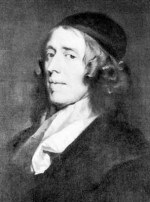
John Owen: Christ the Cornerstone

30 Jan

1616 -1683. Preeminent English Puritan theologian, pastor, and independent.

“Wherefore also,” saith he, “it is contained in the Scripture, Behold, I lay in Sion a chief corner-stone, elect, precious; and he that believeth on him shall not be confounded. Unto you therefore which believe, he is precious; but unto them which be disobedient, the stone which the builders disallowed, the same is made the head of the corner, and a stone of stumbling, and a rock of offence, even to them which stumble at the word, being disobedient: where-unto also they were appointed:” 1 Peter 2:6–8.

Unto them that believe unto the saving of the soul, he is, he always hath been, precious—the sun, the rock, the life, the bread of their souls—every thing that is good, useful, amiable, desirable, here or unto eternity. In, from, and by him, is all their spiritual and eternal life, light, power, growth, consolation, and joy here; with everlasting salvation hereafter. By him alone do they desire, expect, and obtain deliverance from that woful apostasy from God, which is accompanied with—which containeth in it virtually and meritoriously—whatever is evil, noxious, and destructive unto our nature, and which, without relief, will issue in eternal misery. By him are they brought into the nearest cognation, alliance, and friendship with God, the firmest union unto him, and the most holy communion with him, that our finite natures are capable of and so conducted unto the eternal enjoyment of him.

~John Owen~


The Works of John Owen, ed. William H. Goold, vol. 1: Christologia: A Declaration of the Glorious Mystery of the Person of Christ – God and Man (Edinburgh: Banner of Truth Trust, 2008), 3-4.

Books by John Owen

Kindle Books

Biography of John Owen

Other Owen Quotes

Geerhardus Vos – Truly “Knowing” God

29 Jan

God’s self-revelation to us was not made for a primarily intellectual purpose. It is not to be overlooked, of course, that the truly pious mind may through an intellectual contemplation of the divine perfections glorify God. This would be just as truly religious as the intensest occupation of the will in the service of God. But it would not be the full-orbed religion at which, as a whole, revelation aims. It is true, the Gospel teaches that to know God is life eternal. But the concept of ‘knowledge’ here is not to be understood in its Hellenic sense, but in the Shemitic sense. According to the former, ‘to know’ means to mirror the reality of a thing in one’s consciousness. The Shemitic and Biblical idea is to have the reality of something practically interwoven with the inner experience of life. Hence ‘to know’ can stand in the Biblical idiom for ‘to love’, ‘to single out in love.’ Because God desires to be known after this fashion, He has caused His revelation to take place in the milieu of the historical life of a people. The circle of revelation is not a school, but a ‘covenant’.

~Geerhardus Vos~


Biblical Theology: Old and New Testaments (Edinburgh, Scotland; The Banner of Truth Trust; 1975), p. 8.

Books by Geerhardus Vos

Kindle Books

More Vos Quotes at The Old Guys

John Calvin – When The Fewness of Believers Disturbs You

28 Jan

If God has willed this treasure of understanding to be hidden from his children, it is no wonder or absurdity that the multitude of men are so ignorant and stupid! Among the “multitude” I include even certain distinguished folk, until they become engrafted into the body of the church. Besides, Isaiah, warning that the prophetic teaching would be beyond belief, not only to foreigners but also to the Jews who wanted to be reckoned as members of the Lord’s household, at the same time adds the reason: “The arm of God will not be revealed” to all [Isa. 53:1 p.]. Whenever, then, the fewness of believers disturbs us, let the converse come to mind, that only those to whom it is given can comprehend the mysteries of God [cf. Matt. 13:11].

~John Calvin~


Institutes of the Christian Religion, Volumes 1 & 2, ed. John T. McNeill, trans. Ford Lewis Battles, The Library of Christian Classics (Louisville, KY: Westminster John Knox Press, 2011) Vol. 1.7.5. p. 81.

Books by John Calvin

Biography of John Calvin

Kindle Books

Online Books Available

Other Calvin Quotes

George Smeaton and Logos Bible Software

27 Jan

SMEATON-George-210x263

The following is a brief review of three essential works of George Smeaton used in conjunction with Logos Bible Software named: The Smeaton Theology Collection on Logos Bible Software.

So, Who Is George Smeaton?

George Smeaton lived from 1814 to 1889 and is considered to be one of the “most outstanding theologians” of the day. Yet, at the same time, he is so little known in our era.

He studied at Edinburgh University and spend the last 30 years of his life as Chair of Exegetical Theology at New College in Edinburgh. He was a contemporary of as well as a friend with men like Robert Murray McCheyne, Andrew and Horatius Bonar, and Henry Moncrieff. A one time Principle of the Free Church of Scotland, John Macleod, once described Smeaton as “the most eminent scholar of the set of young men who with M’Cheyne and the Bonars sat at the feet of Chalmers.

What Did He Write?

During the course of his life he wrote two wonderfully careful and rich works on the doctrine of the atonement, as well as delivered a series of lectures on the doctrine of the Holy Spirit:

  • The Doctrine of the Atonement as Taught By Christ Himself
  • The Doctrine of the Atonement as Taught By the Apostles
  • The Doctrine of the Holy Spirit

Why Should You Read George Smeaton?

Smeaton’s works on the atonement are wonderfully simple, biblical and profound. Phil Gons describes them as one of the first places one should go when wanting to take a closer look at the atonement of Christ. This certainly is a valid statement. If one is looking to learn about the atonement, the first thing to do is study the Scriptures. Smeaton will be a sure and steady guide as to what Christ himself said regarding the atonement, as well as what his apostles said.

Before that, in the book “The Great Exchange” Sinclair Ferguson spoke of Smeaton as “an outstanding scholar with a brilliant mind and a deep love for Christ.” He then went on to describe his works on the atonement by saying, “these great volumes should regularly be in the hands of every person who teaches and preaches the Gospel of Christ. They are treasure troves.”

Smeaton’s work on the Holy Spirit is just as clear and rigorously Biblical as he seeks to explicate the person and work of the Holy Spirit by exegeting what the Scriptures tell us beginning with the Old Testament and through into the New and now in the life of the church.

Smeaton’s volumes are clear, insightful, exegetical studies of Scripture. Which is what makes them so relevant still today.

Why Read Smeaton in Logos Bible Software?

First, purchasing the hard copies of Smeaton’s three volumes will set you back at least $46 for the two volumes on the atonement. Then, you’ll have to go hunting for his third volume on the Holy Spirit as it appears to be out of print. Once a title makes it into Logos, one doesn’t have to worry about it going in and out of print.

Get the three volume set on Logos for only $32.95 here. This is a special deal for you as a reader of The Old Guys.

Second, as I mentioned above, what makes these works so helpful is how rigorously Biblical Smeaton is. What that means is that these volumes are packed with Biblical references.

If you are like me, you may have to fight the tendency to move too quickly past these references to Bible verses in the different books you read. Instead we have to fight to take the time to read the Scriptures cited by different authors to back up what they are saying. We should do this as people who are most interested in learning what Scripture says and seeking to see if what the author is saying is true is really so.

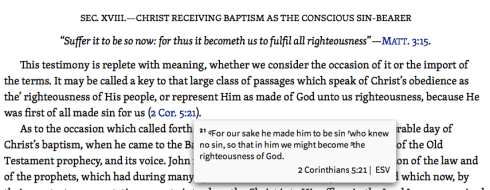
Reading this title in Logos makes this incredibly easy (see the picture below). All one needs to do is hover their mouse over the verse reference and up pops the quotation in full in your favorite Bible version. This is also helpful when verses are quoted in an old book like this in older English and you would like to read it in a more modern translation.
Screen Shot 2014-01-27 at 3.58.01 PM

Third, if a word or concept strikes you as something you would like to dig further into or learn more about it is a matter of a couple clicks (instead of minutes or hours) to access multiple other resources.

Fourth and finally, if you use a mobile phone or tablet with the free Logos Bible app you have these three meaty volumes with you at no additional weight!

Smeaton Logos


Conclusion

George Smeaton’s works are worth inclusion on your bookshelf, digital or physical. Both volumes on the atonement are still in print by Banner of Truth here. However, these wonderful works are made so much more accessible, searchable, and above all easier to weigh against Scripture with Logos Bible Software.

If you are interested, don’t forget to get an Old Guys special on the three volume set on Logos Bible here.


Finally, I’d love to know if any of you have read George Smeaton. What are your thoughts?


John Owen: Four Main Functions of the Holy Spirit

25 Jan

1616 -1683. Preeminent English Puritan theologian, pastor, and independent.

The chief and principal ends for which the Holy Spirit is promised and received may be reduced to these four heads:—(1.) Regeneration; (2.) Sanctification; (3.) Consolation; (4.) Edification. There are, indeed, very many distinct operations and distributions of the Spirit, as I have in part already discovered, and shall yet farther go over them in particular instances; but they may be reduced unto these general heads, or at least they will suffice to exemplify the different manner and ends of the receiving of the Spirit. And this is the plain order and method of these things, as the Scripture both plainly and plentifully testifies:—(1.) He is promised and received as to the work of regeneration unto the elect; (2.) As to the work of sanctification unto the regenerate; (3.) As to the work of consolation unto the sanctified; and, (4.) As unto gifts for edification unto professors, according to his sovereign will and pleasure.

~John Owen~


The Works of John Owen, ed. William H. Goold, vol. 3: Pneumatologia: A Discourse Concerning the Holy Spirit (Edinburgh: T&T Clark, n.d.), 408.

Books by John Owen

Kindle Books

Biography of John Owen

Other Owen Quotes

George Smeaton – Just and Justifier

24 Jan
SMEATON-George-210x263

1814-1889. Scottish minister and Professor of New Testament Exegesis at New College, Edinburgh.

The design or final cause which God had in view in the whole matter of the atonement is next subjoined: that He might be just, and the justifier (Rom. 3:26). The allusion is to the concurrence or harmony of these two perfections of God. The word JUST, applied to God, means that He asserts just claims and inflicts just punishment. It is a perversion of language to interpret the term as if it could mean anything else than justice in the ordinary acceptation of the word among men made in the image of God. The contrast in which it is placed to divine forbearance, and the allusion to the propitiatory, allow no doubt as to its import Justice seemed to slumber during that period of forbearance; now it is displayed.

But this determines the character of the atonement Such language would be unmeaning, if it were not admitted that the atonement is in the proper sense of the word a satisfaction of divine justice. This single clause, therefore, fully warrants the expression in common use, notwithstanding all the objections which have been adduced against it as unfitting or unwarrantable. And when the apostle adds, “that He might be just, AND THE JUSTIFIER,” he alludes to the fact that these two apparently conflicting perfections, justice and grace, meet in full harmony on the cross: justice suffers no violence, and grace has full outlet.

~George Smeaton~


The Doctrine of the Atonement, as Taught by the Apostles (Edinburgh: T&T Clark, 1870), 142-143.

Books by George Smeaton

The Smeaton Theology Collection on Logos Bible Software

Kindle Books

More Smeaton Quotes at The Old Guys

Martin Luther – The Book of Romans

23 Jan

This epistle is really the chief part of the New Testament, and is truly the purest gospel. It is worthy not only that every Christian should know it word for word, by heart, but also that he should occupy himself with it every day, as the daily bread of the soul. We can never read it or ponder over it too much; for the more we deal with it, the more precious it becomes and the better it tastes.

~Martin Luther~


Luther’s Works – Vol. 35: Word and Sacrament I (Philadelphia: Fortress Press, 1999), 365.

Books by Martin Luther

Luther’s Works on Logos Bible Software

Kindle Books

Biography

Other Luther Quotes The Old Guys

Geerhardus Vos – The Greatest Mystery of All

22 Jan

1862-1949. Dutch Reformed pastor who became professor of Biblical Theology at Princeton Seminary. Known as the father of Reformed Biblical Theology.

This is the great mystery that no one can solve–how God could love sinners, without there being anything in them worthy of his love. Mysterious, eternal love of God, you are beyond comprehension!

~Geerhardus Vos~


Grace and Glory: Sermons Preached in the Chapel of Princeton Theological Seminary (Edinburgh, London; Banner of Truth, 1994), p. 213. Sermon XIII: The Spiritual Resurrection of Believers

Books by Geerhardus Vos

Kindle Books

Other Vos Quotes at The Old Guys

John Owen: Sanctification and the Gospel

20 Jan

1616 -1683. Preeminent English Puritan theologian, pastor, and independent.

This whole matter of sanctification and holiness is peculiarly joined with and limited unto the doctrine, truth, and grace of the gospel; for holiness is nothing but the implanting, writing, and realizing of the gospel in our souls.

~John Owen~


The Works of John Owen, ed. William H. Goold, vol. 3: Pneumatologia: A Discourse Concerning the Holy Spirit (Edinburgh: T&T Clark, n.d.), 370-371.

Books by John Owen

Kindle Books

Biography of John Owen

Other Owen Quotes

Wilhelmus à Brakel – The Justice and Grace of God

18 Jan

brakel

Beware, oh sinner, whoever you are, for God is just! Do not imagine that you will be able to satisfy God by praying, “O God, be merciful to me a sinner,” or by doing your utmost to refrain from evil and to practice virtue. To imagine such is to be on the broad way to eternal destruction, and causes millions, who live under the ministry of the gospel, to perish. If you could be delivered from this foolish imagination, there would still be hope for you. As long as you foster such an imagination, however, you are in a hopeless condition. Please consider that there can be no hope of grace and salvation without satisfaction of the justice of God, that is, by the enduring of punishment.

You have heard that God is gracious, which is true. You are guilty, however, of distorting the essential meaning of the grace of God by interpreting it to refer to remission of sin and absolution from punishment apart from satisfaction. Such, however, is not grace. There is no contradiction in God. The justice of God, which cannot be compromised to the least degree, of necessity demands the punishment of the sinner. God cannot deny Himself, and thus grace does not negate His justice. Grace is not incompatible with justice, but confirms it. This is the grace of God so highly exalted in His Word—that God, without finding anything in man, yes, contrary to his desert, gave His Son as a Surety. He transferred the sins of the elect from their account to His and by bearing the punishment justly due upon their sin, satisfied the justice of God on their behalf. This is grace, namely, that God offers Jesus as Surety in the gospel. It is grace when God grants faith to a sinner to receive Jesus and to entrust his soul to Jesus. It is grace when God converts a sinner, granting him spiritual life. It is grace when God permits a sinner to sensibly experience His favor. It is grace when God sanctifies a sinner, leading him in the way of holiness to salvation.

Please note how much the grace of God differs from your conception of grace. Put your erroneous conception aside and cease from trying to make all things well in the way of prayer and self-reformation.

~Wilhelmus à Brakel~


The Christian’s Reasonable Service, ed. Joel R. Beeke, trans. Bartel Elshout, vol. 1 (Grand Rapids, MI: Reformation Heritage Books, 1992), 129-130.

Books by Wilhelmus à Brakel

Kindle Books

More à Brakel Quotes at The Old Guys