

Experience by itself is not sufficient. Scripture is the norm also for our emotional life and tells us what we ought to experience.
~Herman Bavinck~
Reformed Dogmatics Vol. 1: Prolegomena (Grand Rapids, Michigan; Baker Academic; 2003) p. 534.
Experience by itself is not sufficient. Scripture is the norm also for our emotional life and tells us what we ought to experience.
~Herman Bavinck~
Reformed Dogmatics Vol. 1: Prolegomena (Grand Rapids, Michigan; Baker Academic; 2003) p. 534.
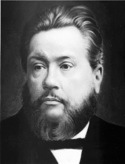
For the herald of the gospel to be spiritually out of order in his own proper person is, both to himself and to his work, a most serious calamity; and yet, my brethren, how easily is such an evil produced, and with what watchfulness must it be guarded against!… It is a terrible thing when the healing balm loses its efficacy through the blunderer who admisters it. You all know the injurious effects frequently produced upon water through flowing along leaden pipes; even so the gospel itself in flowing through men who are spiritually unhealthy, may be debased until it grow injurious to their hearers… Moreover, when a preacher is poor in grace, any lasting good which may be the result of his ministry, will usually be feeble and utterly out of proportion with what might have been expected. Much sowing will be followed by little reaping; the interest upon the talents will be inappreciably small. In two or three of the battles which were lost in the late American war, the result is said to have been due to the bad gunpowder which was served out by certain “shoddy” contractors to the army, so that the due effect of a cannonade was not produced. So it may with us. We may miss our mark, lose our end and aim, and waste our time, through not possesing true vital force within ourselves, or not possesing it in such a degree that God could consitently bless us. Beware of being “shoddy” preachers.
~Charles Spurgeon~
Lectures to My Students (Pasadena, TX; Pilgrim; 1990) p. 2-3
No one is prepared to sacrifice his life for a truth of natural science or mathematics.
~Herman Bavinck~
Reformed Dogmatics Vol. 1: Prolegomena (Grand Rapids, Michigan; Baker Academic; 2003) p. 523.
It will be in vain for me to stock my library, or organise societies, or project schemes, if I neglect the culture of myself; for books, and agencies, and systems, are only remotely the instruments of my holy calling; my own spirit, soul, and body, are my nearest machinery for sacred service; my spiritual faculties, and my inner life, are my battle axe and weapons of war. M’Cheyne, writing to a ministerial friend, who was travelling with a view to perfecting himself in the German tongue, used language identical with our own:–“I know you will apply hard to German, but do not forget the culture of the inner man–I mean of the heart. How diligently the cavalry officer keeps his sabre clean and sharp; every stain he rubs off with the greatest care. Remember you are God’s sword, his instrument–I trust, a chosen vessel unto him to bear his name. In great measure, according to the purity and perfection of the instrument, will be the success. It is not great talents God blesses so much as likeness to Jesus. A holy minister is an awful weapon in the hand of God.”
~Charles Spurgeon~
Lectures to My Students (Pasadena, TX; Pilgrim; 1990) p. 2
Starting today and ending this Friday, August 3rd any who wish will have the opportunity to win a copy of a book written by one of the old guys! We hope to have these giveaways from time to time and our desire is that this will help someone have the opportunity to dive deeper into a specific work by one of our beloved old guys.
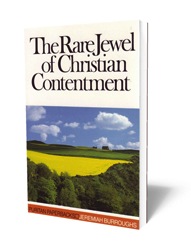
The Author:
Jeremiah Burroughs
The Book:
The Rare Jewel of Christian Contentment
“When times are difficult and God’s people experience loss it is vital that we remember the sufficiency of God our Saviour. Jeremiah Burroughs is a kind of doctor for the Christian soul who points the wounded traveler to the treasure of Christ.” – T. Pruitt
WTS Books describes the book this way:
“Burroughs’ writings, some published before and others after his death, were numerous, but The Rare Jewel of Christian Contentment is one of the most valuable of them all. Its author was much concerned to promote:
peace among believers of various ‘persuasions’
peace and contentment in the hearts of individual believers during what he describes as ‘sad and sinking times’.
The Rare Jewel concentrates upon this second aim. It is marked by sanity, clarity, aptness of illustration, and warmth of appeal to the heart. ‘There is an ark that you may come into, and no men in the world may live such comfortable, cheerful and contented lives as the saints of God’. Burroughs presses his lesson home with all the fervor and cogency of a true and faithful minister of God.”
To Win All You Have to Do Is:
1. Leave a comment below and and let me know that you want to be entered.
2. Subscribe to The Old Guys via RSS, Email, Facebook or Twitter!
3. Leave additional comments for each way you subscribe for extra entries.
A winner will be chosen at random and contacted via email.
In religion no human being and no creature can stand between God and my soul. To live and die in the comfort and blessing of salvation is not possible so long as I must rest on fallible human testimony. In religion we need not less but much stronger and firmer certainty than in science. Peace can be found only in the witness of God.
~Herman Bavinck~
Reformed Dogmatics Vol. 1: Prolegomena (Grand Rapids, Michigan; Baker Academic; 2003) p. 516-517.
Liberty is the heirloom of all the sons and daughters of Adam. But where do you find liberty unaccompanied by religion? True it is that all men have a right to liberty, but it is equally true that you do not meet it in any country save where you find the Spirit of the Lord. “Where the Spirit of the Lord is, there is liberty.” Thank God, this is a free country. This is a land where I can breathe the air and say it is untainted by the groan of a single slave; my lungs receive it, and I know there has never been mingled with its vapours the tear of a single slave woman shed over her child which has been sold from her. This land is the home of liberty. But why is it so? I take it, it is not so much because of our institutions as because the Spirit of the Lord is here–the spirit of true and hearty religion. There was a time, remember, when England was no more free than any other country, when men could not speak their sentiments freely, when kings were despots, when Parliaments were but a name. Who won our liberties for us? Who have loosed our chains? Under the hand of God, I say, the men of religion–men like the great and glorious Cromwell, who would have liberty of conscience, or die–men who, if they could not reach kings’ hearts, because they were unsearchable in cunning, would strike kings low, rather than they would be slaves. We owe our liberty to men of religion, to men of the stern Puritanical school–men who scorned to play the craven and yield their principles at the command of man. And if we ever are to maintain our liberty (as God grant we may) it shall be kept in England by religious liberty–by religion. This Bible is the Magna Charta of old Britain. its truths, its doctrines have snapped our fetters, and they never can be riveted on again, whilst men, with God’s Spirit in their hearts, go forth to speak its truths. In no other land, save where the Bible is unclasped–in no other realm, save where the gospel is preached, can you find liberty. Roam through other countries, and you speak with bated breath; you are afraid; you feel you are under an iron hand; the sword is above you; you are not free. Why? Because you are under the tyranny engendered by a false religion: you have not free Protestantism there; and it is not till Protestantism comes that there can be freedom. It is where the Spirit of the Lord is that there is liberty, and nowhere else. Men talk about being free: they describe model governments, Platonic republics, or Owenite paradises; but they are dreamy theorists; for there can be no freedom in the world, save, “where the spirit of the Lord is.”
~Charles Spurgeon~
Spurgeon’s Sermons
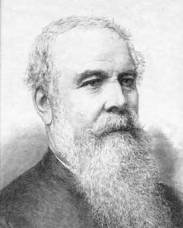
Would we know, for another thing, the strength of a true Christian’s foundation for hope? Let us often read these first five verses of John’s Gospel. Let us mark that the Savior in whom the believer is bid to trust is nothing less than the Eternal God, One able to save to the uttermost all that come to the Father by Him. He that was “with God,” and “was God,” is also “Emmanuel, God with us.” Let us thank God that our help is laid on One that is mighty. (Psalm 89:19.) In ourselves we are great sinners. But in Jesus Christ we have a great Savior. He is a strong foundation-stone, able to bear the weight of a world’s sin. He that believes on Him shall not be confounded. (1 Peter 2:6.)
~J.C. Ryle~
Expository Thoughts on the Gospels – John (Edinburgh, Scotland; Banner of Truth; 1992) Commenting on John 1:1-5.
If Christian revelation, which presupposes the darkness and error of unspiritual humanity, submitted in advance to the judgments of reason, it would by that token contradict itself. It would thereby place itself before a tribunal whose jurisdiction it had first denied.
~Herman Bavinck~
Reformed Dogmatics Vol. 1: Prolegomena (Grand Rapids, Michigan; Baker Academic; 2003) p. 516.
Would we know, for one thing, the exceeding sinfulness of sin? Let us often read these first five verses of John’s Gospel. Let us mark what kind of Being the Redeemer of mankind must needs be, in order to provide eternal redemption for sinners. If no one less than the Eternal God, the Creator and Preserver of all things, could take away the sin of the world, sin must be a far more abominable thing in the sight of God than most men suppose. The right measure of sin’s sinfulness is the dignity of Him who came into the world to save sinners. If Christ is so great, then sin must indeed be sinful!
~J.C. Ryle~
Expository Thoughts on the Gospels – John (Edinburgh, Scotland; Banner of Truth; 1992) Commenting on John 1:1-5.



 The Old Guys