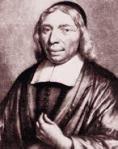
In order to understand the nature of satisfaction correctly, we need to consider the nature of sin, the Judge, and the work of redemption.
(1) Sin brings upon man guilt, wrath, and punishment. If the sinner is to be delivered, he must be acquitted and be delivered from guilt. God must be appeased and the punishment must be borne.
(2) God is the Judge who appears here not so much as a creditor, nor as Lord and offended party, but as Judge. A creditor may forgive a debt if he so desires, and a lord and offended party may relinquish his rights; such freedom of action has been afforded to man by the supreme Judge. A judge, however, may neither relinquish justice nor the punishments due upon crime. However, the manner, time, place, and nature of the punishment, God has left to the discretion of the judge. Since God is the supreme Judge, His justice demands the punishment of the criminal.
(3) The work of satisfaction is contingent upon the diversity of the debt in question. In retiring monetary debts the debtor is not taken into consideration, but only the debt to be paid, which is satisfied with an amount equivalent to the debt. It is immaterial to the creditor whether this debt is paid by the principal debtor or by another who functions as surety. He will be paid with the identical sum of money, which is not a concession at all. With criminal guilt, however, the situation is different. Then the debt cannot be retired by something equivalent in value, but punishment is required for the satisfaction of justice as administered by the judge. Not only the debt or guilt is considered, but also the person who has rendered himself guilty, the criminal. If this satisfaction were to be accomplished by a surety, then, in addition to the surety making satisfaction by bearing the punishment, there must also follow the forgiveness of the criminal. Thus justice would be satisfied; the judge, however, must be willing to admit and accept the surety as well as to punish the incurred guilt in him. Viewing his rights in the absolute sense of the word, the judge would not have to do so. He must thus not impute the punishment to the criminal, but release him from guilt, wrath, and judgment, since all these have been imputed to the surety. Thus mercy and justice, satisfaction and forgiveness meet each other in the atonement, all of which is true in Christ.
~Wilhelmus à Brakel~
The Christian’s Reasonable Service, ed. Joel R. Beeke, trans. Bartel Elshout, vol. 1 (Grand Rapids, MI: Reformation Heritage Books, 1992), 465–466.
Books by Wilhelmus à Brakel
Kindle Books
More à Brakel Quotes at The Old Guys
Tags: The Christians Reasonable Service, WIlhelmus à Brakel









 The Old Guys
Matthew Henry – I Shall Behold Your Face
9 AprHe pleads his own dependence upon God as his portion and happiness. “They have their portion in this life, but as for me (v. 15) I am none of them, I have but little of the world. Nec habeo, nec careo, nec curo—I neither have, nor need, nor care for it. It is the vision and fruition of God that I place my happiness in; that is it I hope for, and comfort myself with the hopes of, and thereby distinguish myself from those who have their portion in this life.” Beholding God’s face with satisfaction may be considered, (1.) As our duty and comfort in this world. We must in righteousness (clothed with Christ’s righteousness, having a good heart and a good life) by faith behold God’s face and set him always before us, must entertain ourselves from day to day with the contemplation of the beauty of the Lord; and, when we awake every morning, we must be satisfied with his likeness set before us in his word, and with his likeness stamped upon us by his renewing grace. Our experience of God’s favour to us, and our conformity to him, should yield us more satisfaction than those have whose belly is filled with the delights of sense. 2. As our recompence and happiness in the other world. With the prospect of that he concluded the foregoing psalm, and so this. That happiness is prepared and designed only for the righteous that are justified and sanctified. They shall be put in possession of it when they awake, when the soul awakes, at death, out of its slumber in the body, and when the body awakes, at the resurrection, out of its slumber in the grave. That blessedness will consist in three things:—[1.] The immediate vision of God and his glory: I shall behold thy face, not, as in this world, through a glass darkly. The knowledge of God will there be perfected and the enlarged intellect filled with it. [2.] The participation of his likeness. Our holiness will there be perfect. This results from the former (1 Jn. 3:2): When he shall appear we shall be like him, for we shall see him as he is. [3.] A complete and full satisfaction resulting from all this: I shall be satisfied, abundantly satisfied with it. There is no satisfaction for a soul but in God, and in his face and likeness, his good-will towards us and his good work in us; and even that satisfaction will not be perfect till we come to heaven.
~Matthew Henry~
Matthew Henry’s Commentary on the Whole Bible: Complete and Unabridged in One Volume (Peabody: Hendrickson, 1994), 765.
Books by Matthew Henry
Kindle Books
Other Matthew Henry Quotes at The Old Guys
Tags: Matthew Henry, Matthew Henry's Commentary on the Whole Bible