Tag Archives: Herman Bavinck

Herman Bavinck: Inspiration – A Confession of Faith

4 Mar

Scripture itself claims that it proceeded from the Spirit of God and maintains this claim over against all criticism. Every attempt to divest it of the mysterious character of its origin, content, and power has up until now ended in defeat and in letting Scripture be Scripture. A [doctrine of] inspiration, therefore, is not an explanation of Scripture, nor actually a theory, but it is and ought to be a believing confession of what Scripture witnesses concerning itself, despite the appearance that is against it. Inspiration is a dogma, like the dogma of the Trinity, the incarnation, etc., which Christians accept, not because they understand the truth of it but because God so attests it. It is not a scientific pronouncement but a confession of faith. In the case of inspiration, as in the case of every other dogma, the question is not in the first place how much can I and may I confess without coming into conflict with science, but what is the witness of God and what, accordingly, is the pronouncement of the Christian faith? And then there is only one possible answer: Scripture presents itself as the word of God and in every century the church of God has recognized it as such. Inspiration is based on the authority of Scripture and has received the affirmation of the church of all the ages.

~Herman Bavinck~


Reformed Dogmatics Vol. 1: Prolegomena (Grand Rapids, Michigan; Baker Academic; 2003) p. 436.

Books by Herman Bavinck

Biography of Herman Bavinck

Other Bavinck Quotes

Herman Bavinck – Without It There is No Comfort in Life or Death

16 Feb

A historical, i.e., a human and fallible authority is not sufficient. Because religion pertains to our salvation and is related to our eternal interests, we can be satisfied with nothing less than divine authority. We must not only know that Scripture is the historical record of our knowledge of Christianity and that it most accurately contains and reproduces the original Christian ideas, but in religion we must know that Scripture is the word and truth of God. Without this certainty there is [for us] no comfort either in life or death. And not only does every Christian need this assurance, but the church itself as institution cannot dispense with this certainty either. For if a minister is not convinced of the divine truth of the word he preaches, his preaching loses all authority, influence, and power. If he is not able to bring a message from God, who then gives him the right to act on behalf of people of like nature with himself? Who gives him the freedom to put himself on a pulpit [a few feet] above them, to speak to them about the highest interests of their soul and life and even to procalim to them their eternal weal or woe? Who would dare, who would be able to do this, unless he has a word of God to proclaim? Both the Christian faith and Christian preaching require divine authority as their foundation. “Faith will totter if the authority of the divine Scriptures begins to waver.”

~Herman Bavinck~


Reformed Dogmatics Vol. 1: Prolegomena (Grand Rapids, Michigan; Baker Academic; 2003) p. 461.

Find more Bavinck resources here.

Biography of Herman Bavinck

Other Bavinck Quotes

Herman Bavinck – Believingly Deriving the Doctrine of Scripture from Scripture

31 Dec

It is incorrect to say that the teaching of inspiration, as it is maintained by the Christian church, forms a contrast to what Scripture says about itself. For inspiration is a fact taught by that very Holy Scripture. Jesus and the apostles have given us their witness concerning Scripture. Scripture contains teachings also about itself. Aside from all the dogmatic or scholastic development of this teaching, the question is simply whether or not Scripture deserves credence at the point of this self-testimony. There may be disagreement about whether Scripture teaches this divine inspiration of itself; but if it does, then it must also be believed at this point just as much as in its pronouncements about God, Christ, salvation, etc. The so-called phenomena of Scripture cannot undo this self-testimony of Scripture and may not be summoned against it as a party in the discussion. For those who make their doctrine of Scripture dependent on historical research into its origination and structure have already begun to reject Scripture’s self-testimony and therefore no longer believe that Scripture. They think it is better to build up the doctrine of Scripture on the foundation of their own research than by believingly deriving it from Scripture itself. In this way, they substitute their own thoughts for, or elevate them above those of Scripture.

~Herman Bavinck~


Reformed Dogmatics Vol. 1: Prolegomena (Grand Rapids, Michigan; Baker Academic; 2003) p. 424.

Books by Herman Bavinck

Biography of Herman Bavinck

More Bavinck Quotes

Herman Bavinck – Why Read Scripture?

27 Dec

The all-perfect author, the Holy Spirit, could inspire nothing untrue, trivial, or degraded. Reading and studying Scripture is therefore an urgent necessity.

~Herman Bavinck~


Reformed Dogmatics Vol. 1: Prolegomena (Grand Rapids, Michigan; Baker Academic; 2003) p. 406-407.

Books by Herman Bavinck

Biography of Herman Bavinck

More Bavinck Quotes

Herman Bavinck – The Extent of His Grace

16 Dec

Salvation is in the one who considered nothing human as alien and through his Holy Spirit joins us to himself through a word that is also fully human and wholly true… Jesus is Savior, and the reach of his grace extends as far as the effects of sin’s corruption.

~Herman Bavinck~


Reformed Dogmatics Vol. 1: Prolegomena (Grand Rapids, Michigan; Baker Academic; 2003) p. 389.

Books by Herman Bavinck

Biography of Herman Bavinck

More Bavinck Quotes

Herman Bavinck – Approaching Scripture

12 Dec

While objections–e.g., from historical criticism–should not be ignored, we must not overlook the spiritual-ethical hostility to Scripture from the forces of unbelief. While not all questioning of Scripture reveals hostile unbelief, it is important to underscore the duty of every person to be humble before Scripture. Holy Scripture must judge us, not the reverse. The Holy Spirit opens our heart to trust, believe, and obey God’s Word in Scripture. Submission remains a struggle, also an intellectual one. We must acknowledge our limitations, the reality of mystery, our weakness of faith, without despairing of all knowledge and truth. Our hope is in Christ, the true man in whom human nature is restored. That is the purpose of Scripture: to make us wise unto salvation (2 Tim. 3:15)

~Herman Bavinck~


Reformed Dogmatics Vol. 1: Prolegomena (Grand Rapids, Michigan; Baker Academic; 2003) p. 389.

Books by Herman Bavinck

Biography of Herman Bavinck

More Bavinck Quotes

Herman Bavinck – No Revelation, No Religion

1 Dec

Now if the recognition of revelation were a philosophical proposition, it would be of relatively little weight. In fact, however, a profound religious interest is at stake here. Religion itself is inter-connected with, and dependent on, revelation. Those who abandon revelation also lose the religion based upon it. The revelation of Scripture and the religion of Scripture stand or fall together.

~Herman Bavinck~


Reformed Dogmatics Vol. 1: Prolegomena (Grand Rapids, Michigan; Baker Academic; 2003) p. 367.

Books by Herman Bavinck

Biography of Herman Bavinck

More Bavinck Quotes

Book of the Week

30 Nov


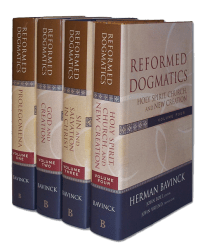
Herman Bavinck’s: Reformed Dogmatics


Arguably the most important systematic theology ever produced in the Reformed tradition – I have found it to be the most valuable. – Richard Gaffin

From the Publisher:

“In partnership with the Dutch Reformed Translation Society, Baker Academic is proud to offer in English for the very first time all four volumes of Herman Bavinck’s complete Reformed Dogmatics. This masterwork will appeal not only to scholars, students, pastors, and laity interested in Reformed theology but also to research and theological libraries.

Includes:
Volume 1: Prolegomena
Volume 2: God and Creation
Volume 3: Sin and Salvation in Christ
Volume 4: Holy Spirit, Church, and New Creation ”

From J.I. Packer:

“Bavinck’s Dutch masterwork was the Everest of which the textbooks by Louis Berkhof and Auguste Leoerf were foothills and Berkouwer’s studies in dogmatics were outliers. Like Augustine, Calvin, and Edwards, Bavinck was a man of giant mind, vast learning, ageless wisdom and great expository skill. Solid but lucid, demanding but satisfying, broad and deep and sharp and stabilizing, Bavinck’s magisterial Reformed Dogmatics remains after a century the supreme achievement of its kind.”


Get the 4 Volume set here.

Or, check out individual volumes:
Volume 1: Prolegomena
Volume 2: God and Creation
Volume 3: Sin and Salvation in Christ
Volume 4: Holy Spirit, Church, and New Creation

Also, there is a newly released abridged version: Reformed Dogmatics Abridged in One Volume

And, another popular digest of his 4 Vol. work written by Bavinck himself: Our Reasonable Faith


Herman Bavinck – Does Christianity Teach Asceticism?

28 Nov

We can even much less think of revelation and nature as opposites when we note the content and purpose of the revelation as given in Christ. For it proclaims to us that God loved the world, and that Christ came not to condemn but to save the world (John 3:16,17), to destroy not the works of the Father but only the works of the devil (1 John 3:8). And just as Christ himself assumed a full human nature, denied the natural life in an ethical sense but did not mutilate and mortify it physically, and in the end again raised his body from the dead, so his disciples, while indeed called to cross-bearing and self-denial and following their Master, are not called to asceticism and world flight.

On the contrary, Jesus prayed to the Father that his disciples would not be taken out of the world but kept in the world from the evil one (John 17:15). In line with this, Christians did not have to go out of the world (1 Cor. 5:10), but to remain in their occupations (1 Cor. 7:17-23); to obey the powers God had ordained (Rom. 13:1); to regard all things their own (1 Cor. 3:21-23); to enjoy every gift of God with thanksgiving (1 Tim. 4:3-5); and to consider godliness as of value in every way, as it hold promise for the present life and also for the life to come (1 Tim. 4:8). And that, too, was what the Reformation wanted: a Christianity that was hostile, not to nature but only to sin.

~Herman Bavinck~


Reformed Dogmatics Vol. 1: Prolegomena (Grand Rapids, Michigan; Baker Academic; 2003) p. 362.

Books by Herman Bavinck

Biography of Herman Bavinck

More Bavinck Quotes

Herman Bavinck – The Organic Inspiration of Scripture

23 Nov

In the doctrine of Scripture, it is the working out and application of the central fact of revelation: the incarnation of the Word. The Word (logos) has become flesh (sarx), and the word has become Scripture; these two facts do not only run parallel but are most intimately connected. Christ became flesh, a servant, without form or comeliness, the most despised of human beings; he descended to the nethermost parts of the earth and became obedient even to the death of the cross. So also, the word, the revelation of God, entered the world of creatureliness, the life and history of humanity, in all the human forms of dream and vision, of investigation and reflection, right down into that which is humanly weak and despised and ignoble. The word became Scripture and as Scripture subjected itself to the fate of all Scripture. All this took place in order that the excellency of the power, also of the power of Scripture, may be God’s and not ours. Just as every human thought and action is the fruit of the action of God in whom we live and have our being, and is at the same time the fruit of the activity of human beings, so also Scripture is totally the product of the Spirit of God, who speaks through the prophets and apostles, and at the same time totally the product of the activity of the authors. “Everything is divine and everything is human”

~Herman Bavinck~


Reformed Dogmatics Vol. 1: Prolegomena (Grand Rapids, Michigan; Baker Academic; 2003) p. 434-435.

Books by Herman Bavinck

Biography of Herman Bavinck

More Bavinck Quotes