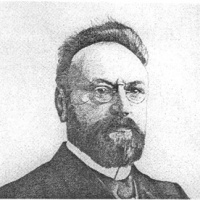
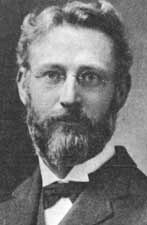
1854-1921. Dutch Reformed Theologian and Churchman. Professor at Free University in Amsterdam.
The cosmological argument attempts to deduce the existence of a cause from the demonstrable existence of an effect. This argument has some validity but fails to tell us anything about the character and nature of the cosmic cause. All we have is a self-existent, first, and absolute World-cause. The teleological argument, proceeding from the world’s order and beauty, takes us one step further to an intelligent cause that must be conscious. However, we still do not know whether this means one intelligent Being or several working in harmony. We are still not nearly at a knowledge of the God of Scripture.
The ontological argument, in its various forms, attempts to infer existence from thought. Our common sense recognizes that this argument is not true when it comes to creatures. Nonexistent beings can be conceived. With God matters are slightly different. Though we cannot convincingly demonstrate the reality of God from our ideas about God, it is true that whenever we do think about God we necessarily think of God existing. The benefit of this argument is that human beings are confronted with the choice of either trusting this necessary witness of their consciousness or else despairing of their own consciousness.
The moral argument infers the existence of a supreme and sovereign Lawgiver from moral phenomena such as human conscience, fear of death and judgment, repentance, and reward and punishment. While these phenomena are powerful witness to the enduring moral nature of even fallen humanity, they are less than a proof for the existence of a righteous and holy God. The same is true for the argument that proceeds from the universal reality of religion. This fact bears powerful witness to the existence, revelation, and knowability of God but cannot as such disprove the claim that it reflects a universal pathology of the human mind, a passing fancy or delusion. Finally, arguments based on the purposefulness of history presuppose what they claim to demonstrate. History is susceptible to different interpretations that are, in the final analysis, a matter of faith, not proof. The heart rather than the intellect is the final arbiter.
That must also be our judgment concerning these “proofs” in general. Even the term “proofs” is infelicitous. The cosmological, teleological, and moral testimony to God is not a matter of logical, mathematical proof but belongs to the category of moral and religious truth.
The proofs may augment and strengthen our faith, but they do not serve as its grounds. They are, rather, the consequences, the products of faith’s observation of the world. The proofs do not induce faith, and objections against them do not wreck it. They are, instead, testimonies by which God is able to strengthen already-given faith.
~Herman Bavinck~
Reformed Dogmatics Vol. 2: God and Creation John Bolt and John Vriend (Grand Rapids, MI; Baker Academic; 2004) p. 55-56.
Books by Herman Bavinck
Kindle Books
The Works of Herman Bavinck on Logos Bible Software.
Biography of Herman Bavinck
More Bavinck Quotes
Tags: Herman Bavinck, Reformed Dogmatics





 The Old Guys
Matthew Henry – I Shall Behold Your Face
9 AprHe pleads his own dependence upon God as his portion and happiness. “They have their portion in this life, but as for me (v. 15) I am none of them, I have but little of the world. Nec habeo, nec careo, nec curo—I neither have, nor need, nor care for it. It is the vision and fruition of God that I place my happiness in; that is it I hope for, and comfort myself with the hopes of, and thereby distinguish myself from those who have their portion in this life.” Beholding God’s face with satisfaction may be considered, (1.) As our duty and comfort in this world. We must in righteousness (clothed with Christ’s righteousness, having a good heart and a good life) by faith behold God’s face and set him always before us, must entertain ourselves from day to day with the contemplation of the beauty of the Lord; and, when we awake every morning, we must be satisfied with his likeness set before us in his word, and with his likeness stamped upon us by his renewing grace. Our experience of God’s favour to us, and our conformity to him, should yield us more satisfaction than those have whose belly is filled with the delights of sense. 2. As our recompence and happiness in the other world. With the prospect of that he concluded the foregoing psalm, and so this. That happiness is prepared and designed only for the righteous that are justified and sanctified. They shall be put in possession of it when they awake, when the soul awakes, at death, out of its slumber in the body, and when the body awakes, at the resurrection, out of its slumber in the grave. That blessedness will consist in three things:—[1.] The immediate vision of God and his glory: I shall behold thy face, not, as in this world, through a glass darkly. The knowledge of God will there be perfected and the enlarged intellect filled with it. [2.] The participation of his likeness. Our holiness will there be perfect. This results from the former (1 Jn. 3:2): When he shall appear we shall be like him, for we shall see him as he is. [3.] A complete and full satisfaction resulting from all this: I shall be satisfied, abundantly satisfied with it. There is no satisfaction for a soul but in God, and in his face and likeness, his good-will towards us and his good work in us; and even that satisfaction will not be perfect till we come to heaven.
~Matthew Henry~
Matthew Henry’s Commentary on the Whole Bible: Complete and Unabridged in One Volume (Peabody: Hendrickson, 1994), 765.
Books by Matthew Henry
Kindle Books
Other Matthew Henry Quotes at The Old Guys
Tags: Matthew Henry, Matthew Henry's Commentary on the Whole Bible