

What, I ask you, would Christ have bestowed upon us if the penalty for our sins were still required? For when we say that he bore all our sins in his body upon the tree [1 Peter 2:24], we mean only that he bore the punishment and vengeance due for our sins. Isaiah has stated this more meaningfully when he says: “The chastisement (or correction) of our peace was upon him” [Isa. 53:5]. What is this “correction of our peace” but the penalty due sins that we would have had to pay before we could become reconciled to God–if he had not taken our place? Lo, you see plainly that Christ bore the penalty of sins to deliver his own people from them… This is why Paul writes that Christ gave himself as a ransom for us [1 Tim. 2:6]. “What is propitiation before the Lord,” asks Augustine, “but sacrifice? What is the sacrifice, but what has been offered for us in the death of Christ?”
~John Calvin~
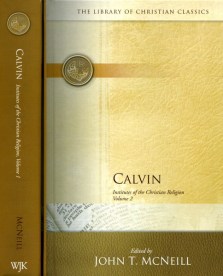
The Institutes of the Christian Religion (Louisville, Kentucky; Westminster John Knox Press; 1974) p. 657.




 The Old Guys
John Calvin – Romans 3:24
9 SepSince there remains nothing for men, as to themselves, but to perish, being smitten by the just judgment of God, they are to be justified freely through his mercy; for Christ comes to the aid of this misery, and communicates himself to believers, so that they find in him alone all those things in which they are wanting. There is, perhaps, no passage in the whole Scripture which illustrates in a more striking manner the efficacy of his righteousness; for it shows that God’s mercy is the efficient cause, that Christ with his blood is the meritorious cause, that the formal or the instrumental cause is faith in the word, and that moreover, the final cause is the glory of the divine justice and goodness.
~John Calvin~
Calvin’s Commentaries (Spokane, Washington; Olive Tree Bible Software; 2010) eBook. Excerpted from his commentary on Romans 3:24.
Read More By Calvin
Read More About Calvin
Other Calvin Quotes
Tags: Calvin's Commentaries, John Calvin