John Calvin – The Turning Point in the Institutes and in Our Lives

10 Oct

The whole human race perished in the person of Adam. Consequently that original excellence and nobility which we have recounted would be of no profit to us but would rather redound to our greater shame, until God, who does not recognize as his handiwork men defiled and corrupted by sin, appeared as Redeemer in the person of his only-begotten Son. Therefore, since we have fallen from life into death, the whole knowledge of God the Creator that we have discussed would be useless unless faith also followed, setting forth for us God our Father in Christ. The natural order was that the frame of the universe4 should be the school in which we were to learn piety, and from it pass over to eternal life and perfect felicity. But after man’s rebellion, our eyes—wherever they turn—encounter God’s curse. This curse, while it seizes and envelops innocent creatures through our fault, must overwhelm our souls with despair. For even if God wills to manifest his fatherly favor to us in many ways, yet we cannot by contemplating the universe infer that he is Father. Rather, conscience presses us within and shows in our sin just cause for his disowning us and not regarding or recognizing us as his sons. Dullness and ingratitude follow, for our minds, as they have been blinded, do not perceive what is true. And as all our senses have become perverted, we wickedly defraud God of his glory.

We must, for this reason, come to Paul’s statement: “Since in the wisdom of God the world did not know God through wisdom, it pleased God through the folly of preaching to save those who believe” [1 Cor. 1:21]. This magnificent theater of heaven and earth, crammed with innumerable miracles, Paul calls the “wisdom of God.” Contemplating it, we ought in wisdom to have known God. But because we have profited so little by it, he calls us to the faith of Christ, which, because it appears foolish, the unbelievers despise.

Therefore, although the preaching of the cross does not agree with our human inclination, if we desire to return to God our Author and Maker, from whom we have been estranged, in order that he may again begin to be our Father, we ought nevertheless to embrace it humbly.

~John Calvin~


Institutes of the Christian Religion, Volumes 1 & 2, ed. John T. McNeill, trans. Ford Lewis Battles, The Library of Christian Classics (Louisville, KY: Westminster John Knox Press, 2011) Vol. 2.6.1. p. 340-341.
Books by John Calvin

Biography of John Calvin

Kindle Books

Online Books Available

Other Calvin Quotes

Francis Turretin – The Highest Art

3 Oct

turretin

Not only do the heavens declare the glory of God, but every blade of grass and flower in the field, every pebble on the shore and every shell in the ocean proclaim not only his power and goodness, but also his manifold wisdom, so near each one that even by feeling, God can be found. Augustine says, “The prophetic voices excepted, the world itself by its own most regular mutability and mobility and the exquisitely beautiful appearance of all visible things, silently as it were proclaims both that it was made and could be made only by a God unspeakably and invisibly great, and unspeakably and invisibly beautiful.”

You may say perhaps that these things were so arranged by chance and by a fortuitous concourse of atoms. But I know not whether such an impious and absurd opinion is worthy of refutation, since these things denote not chance, but the highest art.


~Francis Turretin~


Institutes of Elenctic Theology – Volume 1 (Phillipsburg, NJ; P&R Publishing; 1992) p. 172.

Books by Francis Turretin

Kindle Books

Other Turretin Quotes at The Old Guys

John Calvin – The Trinity: A Distinction, Not a Division

2 Oct

Scripture sets forth a distinction of the Father from the Word, and of the Word from the Spirit. Yet the greatness of the mystery warns us how much reverence and sobriety we ought to use in investigating this. And that passage in Gregory of Nazianzus vastly delights me:
“I cannot think on the one without quickly being encircled by the splendor of the three; nor can I discern the three without being straightway carried back to the one.” Let us not, then, be led to imagine a trinity of persons that keeps our thoughts distracted and does not at once lead them back to that unity. Indeed, the words “Father,” “Son,” and “Spirit” imply a real distinction—let no one think that these titles, whereby God is variously designated from his works, are empty—but a distinction, not a division.

~John Calvin~


Institutes of the Christian Religion, Volumes 1 & 2, ed. John T. McNeill, trans. Ford Lewis Battles, The Library of Christian Classics (Louisville, KY: Westminster John Knox Press, 2011) Vol. 1.8.17. p. 141-142.

Books by John Calvin

Biography of John Calvin

Kindle Books

Online Books Available

Other Calvin Quotes

B.B. Warfield – The Trinity: Revealed and Unique

1 Oct

The term “Trinity” is not a Biblical term, and we are not using Biblical language when we define what is expressed by it as the doctrine that there is one only and true God, but in the unity of the Godhead there are three coeternal and coequal Persons, the same in substance but distinct in subsistence. A doctrine so defined can be spoken of as a Biblical doctrine only on the principle that the sense of Scripture is Scripture. And the definition of a Biblical doctrine in such un-Biblical language can be justified only on the principle that it is better to preserve the truth of Scripture than the words of Scripture. The doctrine of the Trinity lies in Scripture in solution; when it is crystallized from its solvent it does not cease to be Scriptural, but only comes into clearer view. Or, to speak without figure, the doctrine of the Trinity is given to us in Scripture, not in formulated definition, but in fragmentary allusions; when we assembled the disjecta membra into their organic unity, we are not passing from Scripture, but entering more thoroughly into the meaning of Scripture. We may state the doctrine in technical terms, supplied by philosophical reflection; but the doctrine stated is a genuinely Scriptural doctrine.

In point of fact, the doctrine of the Trinity is purely a revealed doctrine. That is to say, it embodies a truth which has never been discovered, and is indiscoverable, by natural reason. With all his searching, man has not been able to find out for himself the deepest things of God. Accordingly, ethnic thought has never attained a Trinitarian conception of God, nor does any ethnic religion present in its representations of the Divine Being any analogy to the doctrine of the Trinity.

Triads of divinities, no doubt, occur in nearly all polytheistic religions, formed under very various influences. Sometimes, as in the Egyptian triad of Osiris, Isis and Horus, it is the analogy of the human family with its father, mother and son which lies at their basis. Sometimes they are the effect of mere syncretism, three deities worshipped in different localities being brought together in the common worship of all. Sometimes, as in the Hindu triad of Brahma, Vishnu and Shiva, they represent the cyclic movement of a pantheistic evolution, and symbolize the three stages of Being, Becoming and Dissolution. Sometimes they are the result apparently of nothing more than an odd human tendency to think in threes, which has given the number three widespread standing as a sacred number (so H. Usener). It is no more than was to be anticipated, that one or another of these triads should now and again be pointed to as the replica (or even the original) of the Christian doctrine of the Trinity. Gladstone found the Trinity in the Homeric mythology, the trident of Poseidon being its symbol. Hegel very naturally found it in the Hindu Trimurti, which indeed is very like his pantheizing notion of what the Trinity is. Others have perceived it in the Buddhist Triratna (Söderblom); or (despite their crass dualism) in some speculations of Parseeism; or, more frequently, in the notional triad of Platonism (e.g., Knapp); while Jules Martin is quite sure that it is present in Philo’s neo-Stoical doctrine of the “powers,” especially when applied to the explanation of Abraham’s three visitors. Of late years, eyes have been turned rather to Babylonia; and H. Zimmern finds a possible forerunner of the Trinity in a Father, Son, and Intercessor, which he discovers in its mythology. It should be needless to say that none of these triads has the slightest resemblance to the Christian doctrine of the Trinity. The Christian doctrine of the Trinity embodies much more than the notion of “threeness,” and beyond their “threeness” these triads have nothing in common with it.


~B.B. Warfield~


The Works of Benjamin B. Warfield, Volume 2: Biblical Doctrines (Edinburg, Scotland; Banner of Truth; 1988) p. 131-135.

Books by B.B. Warfield

Kindle Books

Other Warfield Quotes at The Old Guys

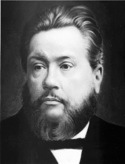
Charles Spurgeon – Conscience on Trial

30 Sep

20120713-214637.jpg


7 For the mind that is set on the flesh is hostile to God, for it does not submit to God’s law; indeed, it cannot. – Romans 8:7

Conscience, I will put thee in the witness box, and cross-examine thee this morning! Conscience, truly answer! be not drugged with the laudanum of self-security! speak the truth! didst thou never hear the heart say, “I wish there were no God?” Have not all men, at times, wished that our religion were not true? Though they could not entirely rid their souls of the idea of the Godhead, did they not wish that there might not be God? Have they not had the desire that it might turn out that all these divine realities were a delusion, a farce, and an imposture? “Yea,” saith every man, “that has crossed my mind sometimes. I have wished I might indulge in folly; I have wished there were no laws to restrain me; I have wished, as the fool, that there were no God.” That passage in the Psalms, “The fool hath said in his heart, there is no God,” is wrongly translated. It should be, “The fool hath said in his heart, no God.” The fool does not say in his heart there is no God, for he knows there is a God; but he says, “No God,—I don’t want any, I wish there were none.” And who amongst us has not been so foolish as to desire that there were no God? Now conscience, answer another question! Thou hast confessed that thou hast at times wished there were no God; now, suppose a man wished another dead, would not that show that he hated him? Yes, it would. And so, my friends, the wish that there were no God, proves that we dislike God. When I wish such a man dead and rotting in his grave; when I desire that he were non est, I must hate that man; otherwise I should not wish him to be extinct. So that wish—and I do not think there has been a man in this world who has not had it—proves that “the carnal mind is enmity against God.”


~Charles Spurgeon~


The New Park Street Pulpit Sermons, Vol. I (London: Passmore & Alabaster, 1855), 149. Vol. 1, Sermon No. 20; Titled: The Carnal Mind Enmity Against God; Delivered on Sabbath Morning, April 22nd, 1855.

Books by Charles Spurgeon

Kindle Books

Biography of Charles Spurgeon

Other Spurgeon Quotes

B.B. Warfield – The Revealed Religion of God

20 Sep

The religion of the Bible thus announces itself, not as the product of men’s search after God, if haply they may feel after Him and find Him, but as the creation in men of the gracious God, forming a people for Himself, that they may show forth His praise. In other words, the religion of the Bible presents itself as distinctively a revealed religion. Or rather, to speak more exactly, it announces itself as the revealed religion, as the only revealed religion; and sets itself as such over against all other religions, which are represented as all products, in a sense in which it is not, of the art and device of man.


~B.B. Warfield~


The Works of Benjamin B. Warfield, Volume 1: Revelation and Inspiration (Grand Rapids, MI; Baker Book House; 2000) p. 4.

Books by B.B. Warfield

Charles Spurgeon – Our Fallenness Apart From Christ

16 Sep

20120713-214637.jpg


7 For the mind that is set on the flesh is hostile to God, for it does not submit to God’s law; indeed, it cannot. – Romans 8:7

The fall of Adam was OUR fall; we fell in and with him; we were equal sufferers; it is the ruin of our own house that we lament, it is the destruction of our own city that we bemoan, when we stand and see written in lines too plain for us to mistake their meaning, “The carnal mind”—that very self-same mind which was once holiness, and has now become carnal—“is enmity against God.” May God help me this morning, solemnly to prefer this indictment against you all! Oh! that the Holy Spirit may so convince us of sin, that we may unanimously plead “guilty” before God.


~Charles Spurgeon~


The New Park Street Pulpit Sermons, Vol. I (London: Passmore & Alabaster, 1855), 149. Vol. 1, Sermon No. 20; Titled: The Carnal Mind Enmity Against God; Delivered on Sabbath Morning, April 22nd, 1855.

Books by Charles Spurgeon

Kindle Books

Biography of Charles Spurgeon

Other Spurgeon Quotes

John Calvin – Students of Scripture

13 Sep

Now, in order that true religion may shine upon us, we ought to hold that it must take its beginning from heavenly doctrine and that no one can get even the slightest taste of right and sound doctrine unless he be a pupil of Scripture. Hence, there also emerges the beginning of true understanding when we reverently embrace what it pleases God there to witness of himself.

~John Calvin~


Institutes of the Christian Religion, Volumes 1 & 2, ed. John T. McNeill, trans. Ford Lewis Battles, The Library of Christian Classics (Louisville, KY: Westminster John Knox Press, 2011) Vol. 1.6.2. p. 72.

Books by John Calvin

Biography of John Calvin

Kindle Books

Online Books Available

Other Calvin Quotes

Read A Puritan Theology With Tim Challies

12 Sep


Tim Challies recently posted on his blog an invitation for anyone interested to read along with him in A Puritan Theology:

Last year Reformation Heritage Books released A Puritan Theology: Doctrine for Life. This work by Joel Beeke and Mark Jones surveys the major doctrines of the Christian faith to find what the Puritans believed. It is a very good book and one that has been a blessing to me. The book looks and sounds intimidating, but is actually surprisingly easy to read, to understand, and to digest. It is exactly the kind of book many of us want to read, but lack the motive or opportunity. I want to help with that.

The final eight chapters are my favorites. They turn from systematic theology to theology in practice. Beeke and Jones show how the Puritans put all of this theology into practice in their lives, their homes, their churches. I read these eight chapters before I read anything else and want to invite you to do the same. They are a great warm-up to the rest of the book but they also stand well on their own.

So here is what I am proposing. Why don’t we read the final eight chapters of A Puritan Theology together. I think you will enjoy them and benefit from them just as much as I did. And just to sweeten the deal a little bit, Joel Beeke is going to join with me in preparing a once-weekly post exploring some of the themes. We will allow him to guide us through the book.

The question I want to ask before each of these chapters is this: What would the Puritans want us to know about life and doctrine? I want to hear how they might guide us, how they might encourage and critique us. And these chapters do that very thing. They focus on the Puritans’ pilgrim mentality as a means of understanding the Christian life; they focus on godly living in the home, on daily prayer and meditation, on conscience and zeal. Each of these is an area where we would do well to listen to those who have gone before us.

Click here to join Tim in reading along.

Purchase the Book:

Kindle: $9.99

Hardcopy: $30.00

Old Guy Kindle Deal: A Puritan Theology 83% Off

4 Sep


A Puritan Theology
Doctrine for Life
ed. by Joel Beeke & Mark Jones
Kindle Price: $9.99

A Puritan Theology: Doctrine for Life offers a groundbreaking treatment of the Puritans’ teaching on most major Reformed doctrines, particularly those doctrines in which the Puritans made significant contributions. Since the late 1950s, nearly 150 Puritan authors and 700 Puritan titles have been reprinted and catalogued by Joel Beeke and Randall Pederson in their 2006 collection of mini-biographies and book reviews, titled, Meet the Puritans. However, no work until now has gathered together the threads of their teaching into a unified tapestry of systematic theology.