
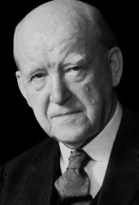
Most of your unhappiness in life is due to the fact that you are listening to yourself instead of talking to yourself.
~Martyn Lloyd-Jones~
Spiritual Depression (Grand Rapids, MI; Eerdmans; 1965) p. 20
Most of your unhappiness in life is due to the fact that you are listening to yourself instead of talking to yourself.
~Martyn Lloyd-Jones~
Spiritual Depression (Grand Rapids, MI; Eerdmans; 1965) p. 20

Now Rome, with its infallible pope, can assert that Scripture is not necessary; the infalliblity of the church indeed renders Scripture superfluous. But Protestantism has no such infallible organ, neither in the institution, nor in the organism, nor in the individual members of the church. If Protestantism should deny the necessity of Scripture, it would weaken itself, strengthen Rome, and lose the truth, which is an indispensable element of religion. For that reason the Reformation insisted so firmly on the necessity of Holy Scripture. Scripture was the place for the Reformation to stand. It succeeded because, against the authority of church councils and the pope, it could pose the authority of God’s Holy Word. One who abandons this position of the Reformation unintentionally works for the upbuilding of Rome. For if not Scripture but the church is necessary to the knowledge of religious truth, then the church becomes the indispensable means of grace. The Word loses its central place and only retains a preparatory or pedagogical role. While Scripture may be useful and good, it is not necessary, neither for the church as a whole, nor for believers individually.
~Herman Bavinck~
Reformed Dogmatics Vol. 1: Prolegomena (Grand Rapids, Michigan; Baker Academic; 2003) p. 469.
[The word of God] stands on a level high above all human authority in state and society, science and art. Before it, all else must yield. For people must obey God rather than other people. All other [human] authority is restricted to its own circle and applies only to its own area. But the authority of Scripture extends to the whole person and over all humankind. It is above the intellect and the will, the heart and the conscience, and cannot be compared with any other authority. Its authority, being divine, is absolute. It is entitled to be believed and obeyed by everyone at all times. In majesty it far transcends all other powers. But, in order to gain recognition and dominion, it asks for no one’s assistance. It does not need the strong arm of the government. It does not need the support of the church and does not conscript anyone’s sword and inquisition. It does not desire to rule by coercion and violence but seeks free and willing recognition. For that reason it brings about its own recognition by the working of the Holy Spirit. Scripture guards its own authority.
~Herman Bavinck~
Reformed Dogmatics Vol. 1: Prolegomena (Grand Rapids, Michigan; Baker Academic; 2003) p. 465.

What was figuratively represented in the Mosaic sacrifices is manifested in Christ, the archetype of the figures. Therefore, to perform a perfect expiation, he gave his own life as an Asham, that is, as an expiatory offering for sin… upon which our stain and punishment might somehow be cast, and cease to be imputed to us…. The Son of God, utterly clean of all fault, nevertheless took upon himself the shame and reproach of our iniquities, and in return clothes us with his purity…. Here, then, is the meaning of this saying: Christ was offered to the Father in death as an expiatory sacrifice that when he discharged all satisfaction through his sacrifice, we might cease to be afraid of God’s wrath.
~John Calvin~
Historical Theology (Grand Rapids, MI; Zondervan Books; 2011) p. 401.
There is nothing humiliating, nor anything that in any way detracts from a person’s freedom, in listening to the word of God like a child and in obeying it. Believing God at his word, i.e., on his authority, is in no way inconsistent with human dignity, anymore than that it dishonors a child to rely with unlimited trust on the word of her or his father. So far from gradually outgrowing this authority, Christian believers rather progressively learn to believe God at his word and to renounce all their own wisdom. On earth believers never move beyond the viewpoint of faith and authority. To the degree that they increase in faith, they cling all the more firmly to the authority of God in his word.
~Herman Bavinck~
Reformed Dogmatics Vol. 1: Prolegomena (Grand Rapids, Michigan; Baker Academic; 2003) p. 464.
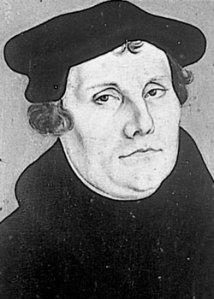
Because an eternal, unchangeable sentence of condemnation has passed upon sin – for God cannot and will not regard sin with favor, but his wrath abides upon it eternally and irrevocably – redemption was not possible without a ransom of such precious worth as to atone for sin, to assume the guilt, pay the price of wrath and thus abolish sin. This no creature was able to do. There was no remedy except for God’s only Son to step into our distress and himself become man, to take upon himself the load of awful and eternal wrath and make his own body and blood a sacrifice for sin. And so he did, out of the immeasurably great mercy and love towards us, giving himself up and bearing the sentence of undending wrath and death.
~Martin Luther~
Historical Theology (Grand Rapids, MI; Zondervan Books; 2011) p.399.
Scripture, like revelation, is an organic whole that has gradually come into being; the mature plant was already enclosed in the seed, the fruit was present in the germ. Revelation and Scripture both kept pace with the state of the church, and vice versa. For that reason one can never draw conclusions for the present based on conditions prevailing in the church in the past. Granted, the church before Moses was without Scripture, and before the completion of revelation the church was never in possession of the whole Bible. But this does not prove anything for the dispensation of the church in which we now live, one in which revelation has ceased and Scripture is complete. For this dispensation Scripture is not only useful and good but also decidedly necessary for the being (esse) of the church.
~Herman Bavinck~
Reformed Dogmatics Vol. 1: Prolegomena (Grand Rapids, Michigan; Baker Academic; 2003) p. 471.
The Gospel does not confine the hearts of men to the enjoyment of the present life, but raises them to the hope of immortality; does not fix them down to earthly delights, but announcing that there is a treasure laid up in heaven, carries the heart thither also.
~John Calvin~
The Institutes of the Christian Religion Vol. 2 (Louisville, Kentucky; Westminster John Knox Press; 1974) Book 2: Knowledge of God the Redeemer; Chapter 10: The Resemblance Between the Old Testament and the New
Hence are those manifold cautions that are given us to take heed that we be not deceived, if we would take heed that we do not sin (see Eph. 5:6; 1 Cor. 6:9; 15:33; Gal. 6:7; Luke 21:8). From all which testimonies we may learn the influence that deceit has into sin, and consequently the advantage that the law of sin has to put forth its power by its deceitfulness. Where it prevails to deceive, it fails not to bring forth its fruit.
The ground of this efficacy of sin by deceit is taken from the faculty of the soul affected with it. Deceit properly affects the mind; it is the mind that is deceived. When sin attempts any other way of entrance into the soul, as by the affections, the mind, retaining its right and sovereignty, is able to give check and control unto it. But where the mind is tainted, the prevalency must be great; for the mind or understanding is the leading faculty of the soul, and what that fixes on, the will and affections rush after, being capable of no con sideration but what that presents unto them. Hence it is, that though the entanglement of the affections unto sin be oftentimes most troublesome, yet the deceit of the mind is always most dangerous, and that because of the place that it possesses in the soul as unto all its operations. Its office is to guide, direct, choose, and lead; and “if the light that is in us be darkness, how great is that darkness!” [Matt. 6:23].
~John Owen~
Overcoming Sin & Temptation (Wheaton, IL; Crossway; 2006) p. 295.



 The Old Guys
Matthew Henry – Tears Wiped Away
18 Apr1 Then I saw a new heaven and a new earth, for the first heaven and the first earth had passed away, and the sea was no more. 2 And I saw the holy city, new Jerusalem, coming down out of heaven from God, prepared as a bride adorned for her husband. 3 And I heard a loud voice from the throne saying, “ Behold, the dwelling place of God is with man. He will dwell with them, and they will be his people, and God himself will be with them as their God. 4 He will wipe away every tear from their eyes, and death shall be no more, neither shall there be mourning, nor crying, nor pain anymore, for the former things have passed away.” – Revelation 21:1-4
This new and blessed state will be free from all trouble and sorrow; for, 1. All the effects of former trouble shall be done away. They have been often before in tears, by reason of sin, of affliction, of the calamities of the church; but now all tears shall be wiped away; no signs, no remembrance of former sorrows shall remain, any further than to make their present felicity the greater. God himself, as their tender Father, with his own kind hand, shall wipe away the tears of his children; and they would not have been without those tears when God shall come and wipe them away. 2. All the causes of future sorrow shall be for ever removed: There shall be neither death nor pain; and therefore no sorrow nor crying; these are things incident to that state in which they were before, but now all former things have passed away.
~Matthew Henry~
Matthew Henry’s Commentary on the Whole Bible (Spokane, WA; Olive Tree Bible Software) Commentary on Revelation 21:4
Books by Matthew Henry
Tags: Matthew Henry, Matthew Henry's Commentary on the Whole Bible