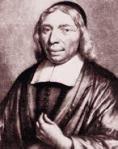
In order to understand the nature of satisfaction correctly, we need to consider the nature of sin, the Judge, and the work of redemption.
(1) Sin brings upon man guilt, wrath, and punishment. If the sinner is to be delivered, he must be acquitted and be delivered from guilt. God must be appeased and the punishment must be borne.
(2) God is the Judge who appears here not so much as a creditor, nor as Lord and offended party, but as Judge. A creditor may forgive a debt if he so desires, and a lord and offended party may relinquish his rights; such freedom of action has been afforded to man by the supreme Judge. A judge, however, may neither relinquish justice nor the punishments due upon crime. However, the manner, time, place, and nature of the punishment, God has left to the discretion of the judge. Since God is the supreme Judge, His justice demands the punishment of the criminal.
(3) The work of satisfaction is contingent upon the diversity of the debt in question. In retiring monetary debts the debtor is not taken into consideration, but only the debt to be paid, which is satisfied with an amount equivalent to the debt. It is immaterial to the creditor whether this debt is paid by the principal debtor or by another who functions as surety. He will be paid with the identical sum of money, which is not a concession at all. With criminal guilt, however, the situation is different. Then the debt cannot be retired by something equivalent in value, but punishment is required for the satisfaction of justice as administered by the judge. Not only the debt or guilt is considered, but also the person who has rendered himself guilty, the criminal. If this satisfaction were to be accomplished by a surety, then, in addition to the surety making satisfaction by bearing the punishment, there must also follow the forgiveness of the criminal. Thus justice would be satisfied; the judge, however, must be willing to admit and accept the surety as well as to punish the incurred guilt in him. Viewing his rights in the absolute sense of the word, the judge would not have to do so. He must thus not impute the punishment to the criminal, but release him from guilt, wrath, and judgment, since all these have been imputed to the surety. Thus mercy and justice, satisfaction and forgiveness meet each other in the atonement, all of which is true in Christ.
~Wilhelmus à Brakel~
The Christian’s Reasonable Service, ed. Joel R. Beeke, trans. Bartel Elshout, vol. 1 (Grand Rapids, MI: Reformation Heritage Books, 1992), 465–466.
Books by Wilhelmus à Brakel
Kindle Books
More à Brakel Quotes at The Old Guys
Tags: The Christians Reasonable Service, WIlhelmus à Brakel








 The Old Guys
John Calvin – The Medicine Doesn’t Feed The Disease
16 AprWhat shall we say then? Are we to continue in sin that grace may abound? 2 By no means! How can we who died to sin still live in it? – Romans 6:1-2
Paul proceeds carefully to disprove the propounded slander. He, however, first rejects it by an indignant negative, in order to impress it on the minds of his readers, that nothing can be more inconsistent than that the grace of Christ, the repairer of our righteousness, should nourish our vices.
Who have died to sin, &c. An argument derived from what is of an opposite character. “He who sins certainly lives to sin; we have died to sin through the grace of Christ; then it is false, that what abolishes sin gives vigour to it.” The state of the case is really this,—that the faithful are never reconciled to God without the gift of regeneration; nay, we are for this end justified,—that we may afterwards serve God in holiness of life. Christ indeed does not cleanse us by his blood, nor render God propitious to us by his expiation, in any other way than by making us partakers of his Spirit, who renews us to a holy life. It would then be a most strange inversion of the work of God were sin to gather strength on account of the grace which is offered to us in Christ; for medicine is not a feeder of the disease, which it destroys.
~John Calvin~
Commentary on the Epistle of Paul the Apostle to the Romans (Bellingham, WA: Logos Bible Software, 2010), 218–219.
Books by John Calvin
Biography of John Calvin
Calvin’s Works on Logos Bible Software
Kindle Books
Online Books Available
Other Calvin Quotes at The Old Guys
Tags: Calvin's Commentaries, John Calvin